














What Does Event Security Do? The Complete Guide to Protecting Guests, Assets, and Reputation
SEO Title: What Does Event Security Do? Hire Professional Event Safety Staff Today
SEO Description: Learn what does event security do, including crowd management, access control, emergency response, VIP protection, and compliance duties, then hire vetted event safety staff today with proven screening and staffing strategies.
About Event Security: Why Protection Is the Backbone of Successful Events
When people ask, “What does event security do?” the short answer is that it protects people, property, and reputation before, during, and after an event. The longer answer is that event security is a coordinated operational function that blends risk assessment, access control, crowd management, emergency response, surveillance, hospitality, and compliance. From small corporate meetings to large public festivals, security professionals create the conditions that allow guests, staff, performers, vendors, and stakeholders to focus on the experience rather than on potential threats.
Modern event security is not simply about placing guards at doors. It is about designing a layered defense. Security teams assess the venue, identify hazards, manage entry and exit points, monitor crowd behavior, respond to incidents, support emergency services, and maintain clear communication with event leaders. In many cases, they also shape guest experience. A calm, professional security presence can make attendees feel safe, welcomed, and confident that the organizers have prepared for the unexpected.
For employers, venue operators, event planners, production companies, and hospitality businesses, the real question is not only what event security does, but how to hire the right people to do it. Effective security staffing requires vetted personnel, clear job specifications, training standards, shift planning, escalation protocols, and reliable recruitment partners. The sections below break down the full scope of event security responsibilities and provide practical guidance for hiring teams that can perform under pressure.
Interactive Overview: What Event Security Teams Manage by Category
Event security work can be grouped into several major categories. Use the tabs below to explore how different security functions contribute to a safe, efficient, and professional event environment.
Public Safety and Threat Prevention
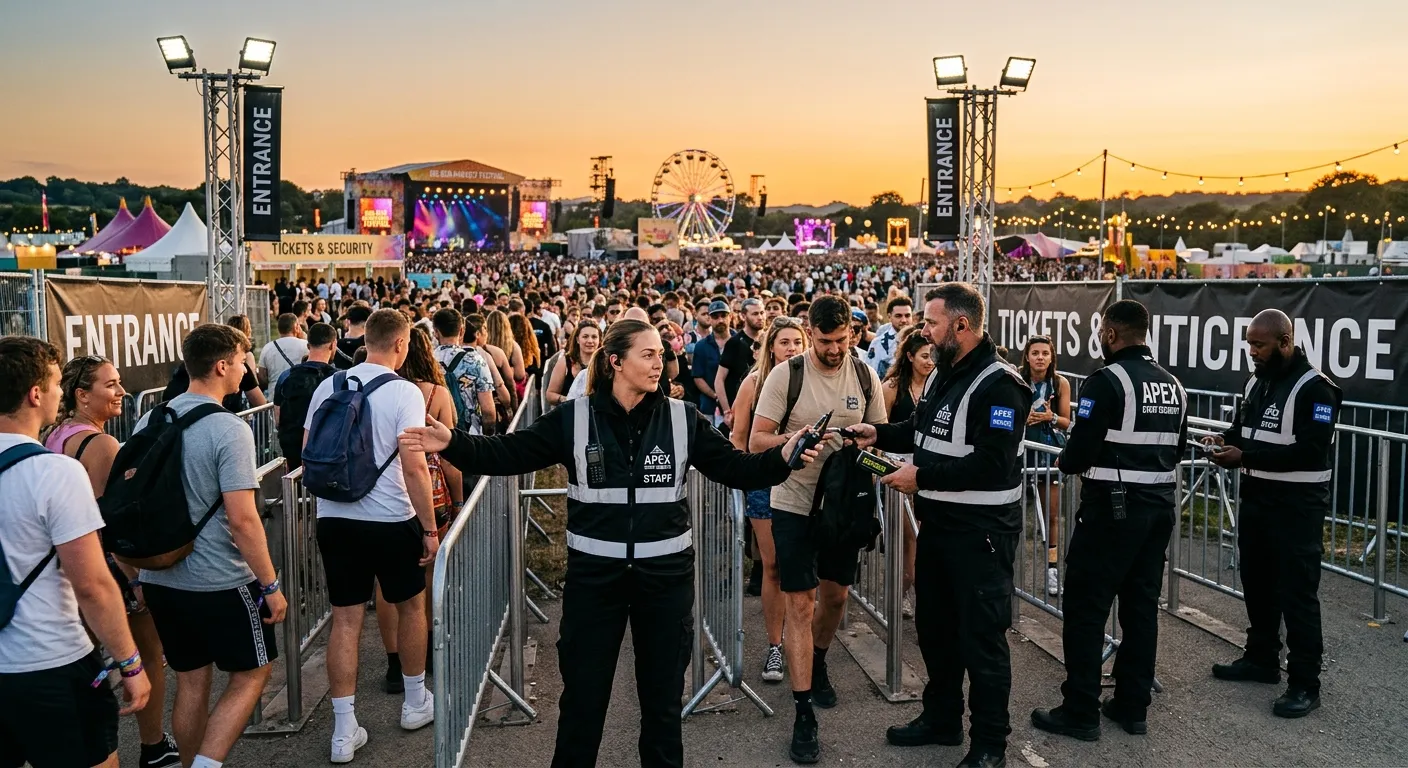
Public safety is the foundation of event security. Teams prevent incidents through visible deterrence, controlled entry, bag checks, prohibited item screening, perimeter monitoring, and coordinated patrols. They also watch for behavioral warning signs such as aggression, intoxication, overcrowding, or unauthorized access.
- • Monitor entrances, exits, parking areas, and crowd density.
- • Identify suspicious behavior, unattended items, or potential weapons.
- • Support emergency medical response and evacuation planning.
- • Coordinate with police, fire services, venue managers, and production staff.
Guest Experience and Conflict Management
Security staff are often the first and last people guests interact with. A professional approach can reduce anxiety, clarify instructions, and prevent minor disputes from escalating. Event security does not only enforce rules; it guides behavior and supports a welcoming atmosphere.
- • Provide clear directions, entry assistance, and accessibility support.
- • De-escalate conflicts using calm communication and problem-solving.
- • Manage queue behavior and prevent bottlenecks at high-traffic points.
- • Protect VIP guests while maintaining a positive public-facing presence.
Operational Flow and Access Control
Event operations depend on controlled movement. Security teams regulate who enters which zones, when, and under what conditions. This is especially important for conferences, concerts, sports events, exhibitions, film sets, and corporate gatherings where different areas have different risk levels.
- • Check tickets, credentials, wristbands, and staff passes.
- • Control access to backstage, production, media, and VIP zones.
- • Manage vehicle entry, loading bays, and delivery schedules.
- • Maintain communication channels through radios, control rooms, and supervisors.
Compliance, Reporting, and Continuous Improvement
Professional security creates an audit trail. Incident reports, patrol logs, access records, CCTV notes, and shift handovers help organizers prove due diligence. Compliance also ensures security actions remain lawful, proportionate, and aligned with venue policies and local regulations.
- • Document incidents, refusals of entry, and emergency activations.
- • Follow data protection and surveillance usage rules.
- • Maintain licensing, training, and vetting records where required.
- • Provide post-event reviews to improve future planning.
Key Benefits of Professional Event Security
Investing in structured security staffing delivers measurable benefits beyond simple protection. These advantages help organizers reduce risk, improve operations, and strengthen stakeholder confidence.
Risk Reduction
Professional teams identify hazards early and prevent incidents before they become costly, dangerous, or reputationally damaging.
Guest Confidence
Visible, calm security reassures attendees that organizers have planned responsibly and can respond effectively if something goes wrong.
Crowd Control
Security staff manage movement, queues, barriers, and capacity limits to reduce crushing risks, bottlenecks, and unsafe congestion.
Asset Protection
From equipment and props to vehicles and merchandise, security teams help prevent theft, damage, tampering, and unauthorized access.
Emergency Readiness
Trained staff support evacuation, medical response, fire safety, lockdowns, and coordination with emergency services.
Operational Efficiency
Clear access control, communication, and supervision help events run on schedule with fewer disruptions.
What Does Event Security Do During an Event? A Deep Dive
1. Pre-Event Planning and Risk Assessment
Before doors open, security teams analyze the event format, audience profile, venue layout, expected attendance, local crime patterns, weather conditions, and stakeholder requirements. A risk assessment identifies likely threats and determines the appropriate staffing level, equipment, patrol routes, and emergency procedures. Organizers should expect security planning to include site visits, access mapping, barrier placement, communication plans, and contingency protocols.
2. Access Control and Credentialing
Access control is one of the most visible responsibilities. Security staff verify tickets, passes, wristbands, invitations, and staff credentials. They separate general attendees from VIPs, media, performers, vendors, and production teams. Effective credentialing prevents unauthorized entry, reduces fraud, and protects restricted areas such as backstage zones, control rooms, storage areas, and executive suites.
3. Crowd Management and Flow Design
Crowd management is not the same as crowd control. Security teams design movement routes, monitor density, and adjust barriers to prevent unsafe congestion. They may manage queuing systems, one-way flows, exit routes, emergency lanes, and capacity thresholds. At large events, poor crowd flow can create serious safety hazards, so trained staff must understand both behavioral dynamics and venue limitations.
4. Surveillance, Patrols, and Incident Detection
Security teams use CCTV, foot patrols, mobile radios, access logs, and control-room monitoring to detect problems early. Patrols may be fixed, rotating, or random depending on risk. In large venues, a combination of static posts and dynamic patrols provides layered coverage. Surveillance is most effective when staff are trained to recognize unusual behavior, unattended items, structural hazards, and signs of distress among guests.
Pro Tip: Watch for Behavioral Signals, Not Just Uniforms
Experienced event security professionals look beyond obvious threats. Aggressive posturing, repeated attempts to enter restricted areas, unattended bags, excessive intoxication, and panic in a crowd can all indicate emerging problems. Training staff to observe, communicate, and escalate calmly is often more valuable than simply increasing the number of guards.
5. Emergency Response and Evacuation Support
When emergencies occur, security teams become first responders. They may activate alarms, guide attendees to exits, assist injured persons, manage smoke or fire hazards, and coordinate with police, fire departments, and medical teams. Evacuation support requires clear signage, trained staff, accessible routes, and regular drills for large or high-risk events.
6. VIP, Artist, and Executive Protection
Some events require close protection for high-profile guests. Security teams may manage private entrances, escort VIPs through public areas, monitor fan interactions, and prevent unauthorized photography or approach. Executive protection is especially important at award ceremonies, political events, product launches, sports fixtures, and entertainment productions where public exposure increases risk.
7. Customer Service and Conflict De-escalation
Event security staff often answer questions, resolve seating disputes, assist people with accessibility needs, and manage intoxicated or distressed guests. De-escalation is a core skill. A firm but respectful tone can prevent arguments, refusals of service, or confrontations from becoming physical incidents. Security teams should be trained in communication, emotional regulation, and lawful use of force.
Expert Insight: Security Is Also Hospitality
Many event organizers underestimate how much guest experience depends on security behavior. A guard who speaks clearly, respects personal space, and explains rules without aggression can prevent complaints, reduce conflict, and improve compliance. The best security teams are trained not only in enforcement but also in service delivery.
For hospitality venues, conferences, and public festivals, this dual capability is essential. If you are hiring staff for volatile guest environments, reviewing flexible staffing approaches can help you build resilient teams. For example, event volatility and shift demands often require rapid adjustments, and organizers can learn more about mastering temp job agencies to maintain coverage without sacrificing service quality.
8. Post-Event Reporting and Continuous Improvement
After an event, security teams produce reports covering incidents, access refusals, lost property, injuries, crowd issues, equipment problems, and emergency activations. These records support insurance claims, police inquiries, internal reviews, and future planning. Continuous improvement is essential: organizers should analyze what worked, what failed, and how staffing, training, or venue layout can be refined for the next event.
Video: Understanding Event Staffing Volatility
Event staffing is rarely static. Demand can shift suddenly because of weather, attendance changes, production delays, guest behavior, or emergency response requirements. This video provides practical insight into handling flexible staffing needs in event-driven environments.
9. Property, Equipment, and Supply Protection
Events involve expensive assets: sound systems, lighting rigs, props, vehicles, merchandise, catering equipment, and production tools. Security staff protect these assets by controlling loading areas, monitoring storage rooms, checking vendor access, and preventing theft or tampering. In film, television, and live production settings, asset protection is closely tied to crew safety and schedule reliability.
10. Coordination with Venue, Police, and Emergency Services
Event security does not operate in isolation. Teams coordinate with venue managers, production supervisors, catering staff, medical providers, local authorities, and emergency responders. Clear communication prevents duplicated efforts, reduces confusion during incidents, and ensures that everyone follows the same escalation path. For large-scale events, a control room or incident management system is often essential.
Actionable Advice: Build a Simple Escalation Matrix
Every event security plan should include a clear escalation matrix. Define who handles minor issues, who contacts supervisors, who calls emergency services, and who communicates with senior organizers. Without this structure, teams may delay critical responses or make inconsistent decisions under pressure.
How to Hire Event Security Staff: Screening, Staffing, and Budgeting
Understanding what event security does is only half the challenge. The other half is hiring personnel who can execute those responsibilities reliably. Event security roles require trust, judgment, communication, physical awareness, and adherence to legal and organizational standards. Poorly screened staff can create liability, reduce guest confidence, and increase incident risk.
Define the Role Before You Hire
Start with a clear job specification. Are you hiring door security, patrol officers, control room operators, VIP protection, crowd stewards, or event supervisors? Each role has different responsibilities. A ticket checker may need strong customer service skills, while a supervisor may need leadership, radio communication, and emergency planning experience. Defining duties early helps you screen candidates against the right competencies.
Use Strong Candidate Screening Practices
Security roles demand higher vetting standards than many general temporary positions. Background checks, references, right-to-work verification, licensing checks, training records, and behavioral interviews are critical. Organizers should also assess communication skills and conflict-handling ability. For practical guidance on building stronger hiring pipelines, review candidate screening strategies for elite talent identification and apply those principles to security recruitment.
Consider Flexible Staffing for Event Demand
Event staffing is often seasonal, short-term, or last-minute. A festival may need dozens of stewards for three days, while a corporate conference may require a smaller team for one shift. Flexible staffing models can help organizers scale up or down quickly. If you need rapid access to vetted personnel, explore how to book temporary staff quickly and consider professional staffing services that support event, hospitality, and industrial environments.
Budget for Quality, Not Just Headcount
Security budgets should reflect risk, not only attendance. A high-risk public event may need more supervisors, medical support, surveillance, and communication equipment than a low-risk private meeting. Some organizations benchmark staffing costs against other facilities or building management roles. If HR teams are researching pay comparisons such as Gaji Building Management Staff Bca, they should apply the same data-driven discipline to event security budgets by comparing role complexity, shift length, licensing requirements, training standards, and local market rates.
Pro Tip: Pair Security Hiring with HR Strategy
Event security staffing should not be treated as a one-off purchase. It connects to onboarding, compliance, scheduling, training, and employee retention. If you are building a repeatable hiring process, read how to optimize hire employees and align your recruitment workflow with broader HR solutions for talent acquisition.
Train Staff for the Specific Event Environment
Even experienced security staff need event-specific training. They should understand venue layout, emergency exits, radio codes, prohibited items, escalation procedures, accessibility needs, and customer service expectations. Briefings should be short, practical, and documented. For multi-day events, supervisors should run daily debriefs to adjust plans based on what occurred the previous shift.
Measure Performance After the Event
Review incident reports, staffing attendance, response times, guest feedback, and supervisor evaluations. This information helps refine future hiring specifications. Did the team need more patrol coverage? Were entry checks too slow? Did communication break down during an emergency? Measuring performance turns event security from a reactive cost into a strategic operational capability.
Event Security FAQ: Practical Answers for Organizers
Festival security manages entry checks, crowd flow, prohibited items, medical incidents, stage area access, vendor zones, and emergency evacuations. Teams may also monitor alcohol consumption, protect equipment, and coordinate with local authorities.
Yes, especially when the event includes executives, media, high-value assets, restricted access, or large guest numbers. Corporate security may focus on credential checks, building access, fire exits, parking control, and confidential information protection.
Security guards often have enforcement-focused responsibilities and may require specific licensing. Stewards typically manage customer guidance, crowd flow, and event assistance. Many organizations use both, depending on risk level and venue requirements.
There is no universal ratio. The number depends on attendee volume, venue size, entry points, risk profile, event duration, alcohol service, VIP presence, and local regulations. A professional risk assessment is the best way to determine staffing levels.
Training should include conflict de-escalation, emergency evacuation, first aid awareness, fire safety, access control, radio communication, customer service, legal responsibilities, and venue-specific procedures.
Yes. Many organizers use staffing agencies or specialist security contractors to provide vetted personnel, supervisors, and temporary teams. Outsourcing can improve flexibility, reduce recruitment pressure, and provide access to experienced event staff.
Security teams should provide incident reports, duty logs, patrol records, access refusals, lost property records, emergency response notes, and post-event reviews. These documents support compliance and continuous improvement.
Prepare clear role specifications, define shift times, identify required skills, and work with a staffing partner that can screen candidates quickly. Posting the role early and using a trusted recruitment workflow helps reduce time-to-hire while maintaining quality.
Ready to Hire Professional Event Security Staff?
Event safety depends on the right people in the right roles. Whether you need crowd stewards, access control officers, supervisors, or full event security teams, start by posting your requirements and connecting with vetted candidates who can protect your guests, assets, and reputation.
From planning and screening to onboarding and flexible deployment, strong recruitment strategy is essential for safe, smooth, and professionally managed events.